
A few years ago, I remember sitting with a cup of coffee and thinking about how differently wealthy people seem to look at money. Most of us think about earning a salary, paying bills, saving what is left, and repeating the cycle. Then I came across Robert Kiyosaki’s ideas, and one phrase immediately caught my attention: make your money work for you.
That idea is at the heart of Kiyosaki’s financial philosophy. He became famous through his bestselling book Rich Dad Poor Dad, but his career goes far beyond writing books. He has been an entrepreneur, investor, educator, and businessman.
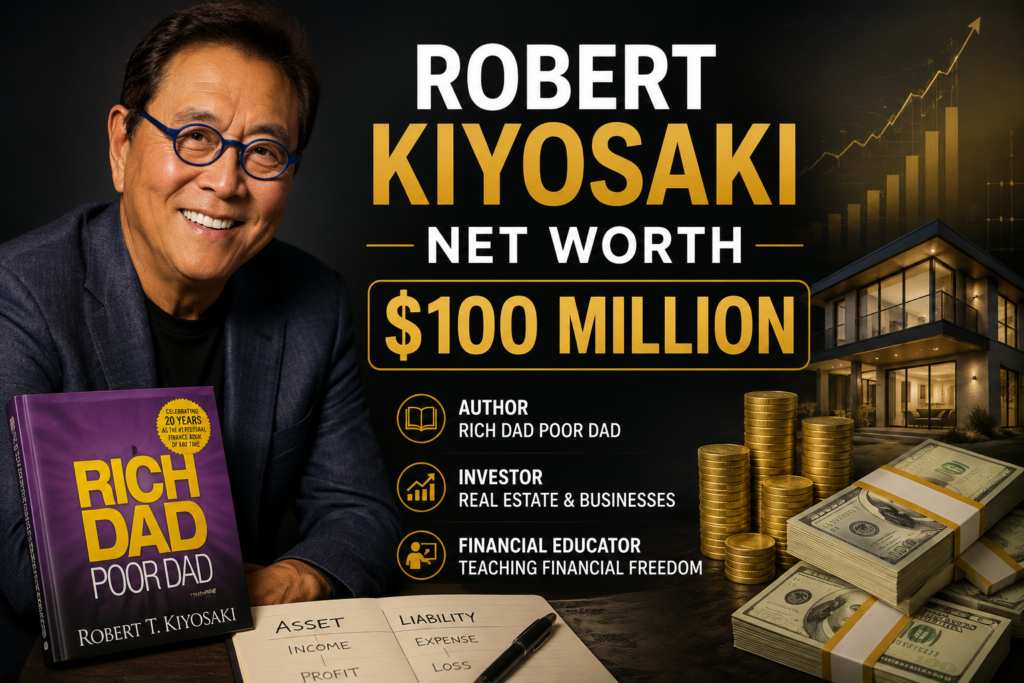
So, what is Robert Kiyosaki net worth today? Current public estimates place his net worth at around $100 million. However, it’s important to remember that celebrity net-worth figures are estimates, not audited financial statements.
In this article, I’ll take a closer look at how Kiyosaki built his wealth, where his money comes from, his investment philosophy, and what I think we can learn from his journey.
Robert Kiyosaki Net Worth at a Glance
Before getting into his story, here’s a quick overview:
- Full Name: Robert Toru Kiyosaki
- Born: April 8, 1947
- Birthplace: Hilo, Hawaii
- Profession: Author, entrepreneur, investor, and financial educator
- Best Known For: Rich Dad Poor Dad
- Estimated Net Worth: Approximately $100 million
- Major Areas of Interest: Real estate, business, precious metals, and other investments
- Major Brand: The Rich Dad Company
Kiyosaki’s official biography describes him as an entrepreneur, educator, and investor who has spent decades teaching people about financial independence.
How Robert Kiyosaki Became Famous
Robert Kiyosaki didn’t become wealthy simply by publishing one successful book.
His journey included business experiments, setbacks, military service, sales experience, and eventually a major shift toward financial education.
After serving in the U.S. Marine Corps, Kiyosaki entered the business world. He later worked for Xerox, where he developed important sales skills. According to his official biography, he eventually became the company’s top salesperson in Hawaii.
That experience mattered because Kiyosaki often emphasizes sales and communication as important entrepreneurial skills.
He later started businesses of his own. Some worked, while others struggled. Those failures became part of the story he would eventually share with millions of readers.
The Birth of the Rich Dad Philosophy
Kiyosaki says his thinking about money was strongly influenced by two father figures.
His biological father represented traditional education and career thinking, while his friend’s father—whom Kiyosaki calls his “Rich Dad”—introduced him to entrepreneurship, investing, and financial education.
Whether readers agree with every part of the story or not, the concept became incredibly powerful.
Instead of asking only, “How much money do I earn?” Kiyosaki encourages people to ask, “How much money do my assets produce?”
That distinction became one of the central ideas behind his financial education brand.
Rich Dad Poor Dad Changed Everything
The biggest turning point in Kiyosaki’s career came with Rich Dad Poor Dad, first published in 1997.
The book challenged conventional ideas about employment, homeownership, investing, assets, liabilities, and financial education. Its simple storytelling style helped introduce complicated money concepts to ordinary readers.
The book became an international bestseller and has sold tens of millions of copies worldwide. Penguin Random House notes that it has been translated into numerous languages and sold more than 40 million copies.
For me, this is one of the most interesting parts of Kiyosaki’s wealth story.
He didn’t just make money from writing a book. He built an entire business ecosystem around financial education.
That ecosystem included books, educational products, games, seminars, courses, and other resources.
How Robert Kiyosaki Makes His Money
When discussing Robert Kiyosaki net worth, it’s easy to focus on one number. I think it’s more useful to understand the different income sources behind his career.
Book Sales
Books are obviously one of Kiyosaki’s biggest sources of commercial success.
Rich Dad Poor Dad became the foundation for the Rich Dad brand, followed by numerous additional books covering entrepreneurship, investing, money, and financial education.
His publishing success gave him both income and global recognition.
The Rich Dad Company
Kiyosaki and Kim Kiyosaki co-founded The Rich Dad Company, which expanded his financial education business beyond books.
The company offers educational products and experiences focused on investing, entrepreneurship, and financial independence.
This is an important part of understanding his business model.
Instead of relying entirely on book royalties, the brand developed multiple ways to reach its audience.
Real Estate Investments
Real estate has long been a major part of Kiyosaki’s investment philosophy.
He frequently talks about purchasing assets that can generate income rather than simply accumulating possessions that create expenses.
His broader investment approach has included income-producing real estate and businesses.
This doesn’t mean every real estate investment is automatically profitable. Property comes with taxes, maintenance, financing costs, vacancies, and market risk.
That’s something I think is worth remembering whenever someone talks about real estate as an easy path to wealth.
Speaking and Financial Education
Kiyosaki has also built a career around speaking, teaching, podcasts, educational programs, and public appearances.
His ability to turn financial concepts into memorable stories has helped him maintain a large audience for decades.
The Rich Dad Company describes its mission as improving financial well-being through financial education.
Robert Kiyosaki and the $1.2 Billion Debt Story
This is where the subject becomes particularly interesting.
Recent reporting says Kiyosaki has publicly discussed approximately $1.2 billion in debt connected to his investment strategy. That sounds shocking when you first hear it.
However, the situation is more complicated than simply saying “Robert Kiyosaki owes $1.2 billion personally.”
Recent reports say the debt is associated largely with leveraged real-estate investments and business structures. His former wife and business partner Kim Kiyosaki has also explained that the headline figure does not necessarily represent his personal liability in the straightforward way people might assume.
This actually connects directly with one of Kiyosaki’s most controversial financial ideas: using debt to acquire income-producing assets.
But here’s my personal tip: don’t copy a millionaire’s debt strategy simply because it worked for them.
Borrowing money can increase returns, but it can also magnify losses. Anyone considering leverage should understand interest rates, cash flow, taxes, legal structures, and worst-case scenarios first.
What Robert Kiyosaki’s Investment Philosophy Teaches
Kiyosaki’s approach can be summarized through a few recurring ideas.
Assets vs. Liabilities
One of his best-known lessons is to understand the difference between assets and liabilities.
He encourages people to focus on things that can potentially put money into their pockets.
Examples might include:
- Rental properties
- Businesses
- Investments
- Intellectual property
- Income-producing assets
The exact definition can vary depending on the accounting context, but the underlying lesson is simple: understand where your money is going.
Financial Education Matters
Kiyosaki argues that traditional education doesn’t necessarily teach people how money works.
That’s one reason financial literacy has become such a major part of his brand.
My second personal tip is simple: before putting money into stocks, property, cryptocurrency, or any other investment, spend time learning how it works.
A few hours of research can save you from making an expensive mistake.
Lessons I Take From Robert Kiyosaki’s Success
Whether you agree with all of Kiyosaki’s ideas or not, I think there are several useful lessons in his career.
Don’t Depend on One Income Source
Kiyosaki built income through books, businesses, investments, education, and intellectual property.
That reminds me of something I often tell people: one paycheck can pay the bills, but developing additional income-producing assets can potentially give you more financial flexibility.
Learn From Failure
Kiyosaki’s story wasn’t a straight line to success.
He experienced business failures and financial difficulties before becoming internationally successful. His official company biography even describes periods of financial struggle and near-bankruptcy.
That’s encouraging because it shows that a failed business doesn’t necessarily mean the end of an entrepreneurial journey.
Think Long Term
Building substantial wealth rarely happens overnight.
Kiyosaki has spent decades building his personal brand and investment philosophy. The lesson I take from that is to focus less on quick wins and more on developing skills and assets that can compound over time.
Robert Kiyosaki Net Worth Compared With His Influence
A $100 million estimate is impressive, but I would argue that Kiyosaki’s influence may be even more significant than the number itself.
Rich Dad Poor Dad introduced millions of readers to ideas such as passive income, entrepreneurship, financial literacy, and investing.
His opinions are sometimes controversial, and not every financial expert agrees with his recommendations.
Still, few personal-finance authors have managed to make conversations about money as mainstream as Kiyosaki has.
Final Thoughts on Robert Kiyosaki Net Worth
When I look at Robert Kiyosaki net worth, the most interesting part isn’t simply the estimated $100 million figure. It’s the business system and philosophy he built around financial education.
From early business failures to the success of Rich Dad Poor Dad, Kiyosaki turned his experiences into books, educational products, investments, and a recognizable global brand.
His story also comes with an important reminder: wealth isn’t just about having a large number in a bank account. Assets, liabilities, cash flow, risk, and financial knowledge all matter.