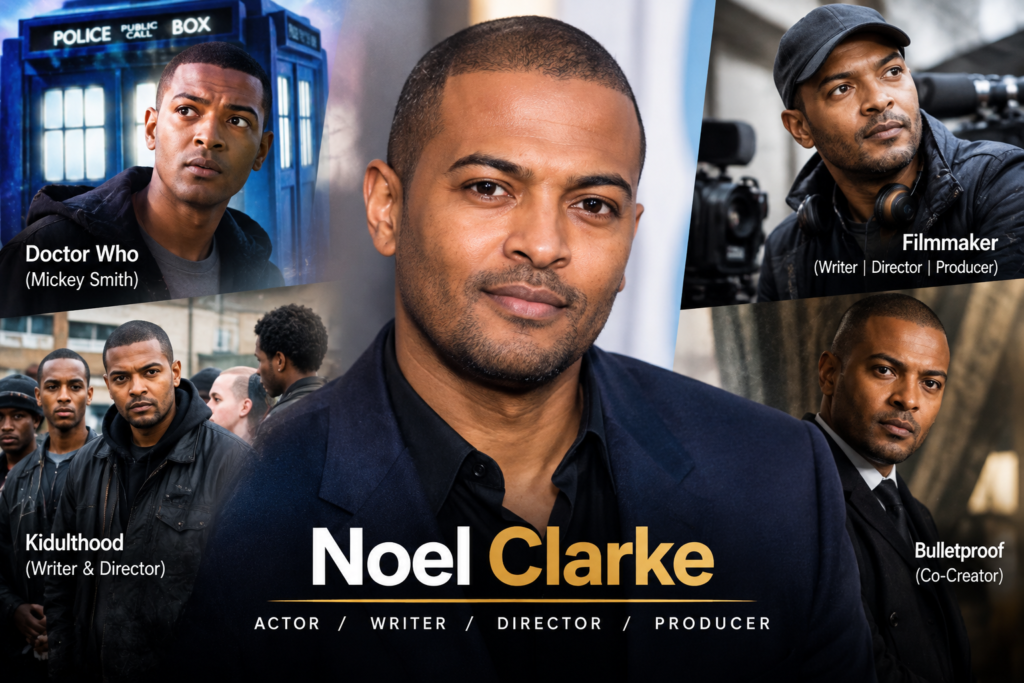

I first came across Noel Clarke through Doctor Who. At the time, I knew him mainly as Mickey Smith, the character who seemed to be constantly caught between ordinary life and the strange world surrounding the Doctor.
Later, I discovered that Clarke was much more than an actor. He had also written films, directed them, produced projects, and helped bring stories about young Black British characters to a much wider audience.
That combination is what makes his career interesting to look back at. From television and theatre to Kidulthood, Adulthood, Brotherhood, and Hollywood productions, Noel Clarke has experienced some remarkable highs.
His career has also faced serious controversy and legal developments in recent years, making his story considerably more complicated today.
Who Is Noel Clarke?
Noel Clarke is an English actor, writer, director, producer, and filmmaker from London. He was born in 1975 and studied media before training as an actor at London’s Actors Centre.
Before becoming a familiar face on television, Clarke worked in theatre and smaller television productions. His stage work earned him a Laurence Olivier Award in 2003 for Where Do We Live, an early sign that he was capable of more than simply appearing in front of a camera.
What I find particularly interesting about his early career is that he didn’t stay in one lane.
He wasn’t satisfied with simply acting in someone else’s story. Eventually, he started creating stories of his own.
Noel Clarke and Doctor Who
For many viewers, Noel Clarke and Doctor Who will always be connected.
Clarke played Mickey Smith, a recurring character in the revived Doctor Who series. He appeared during the Christopher Eccleston and David Tennant eras, with the character becoming an important part of Rose Tyler’s story.
Mickey initially came across as an ordinary young man dealing with a difficult relationship. As the series progressed, however, his character became more confident and capable.
I think that development helped Clarke make a strong impression on viewers. Mickey wasn’t introduced as a superhero or genius. He was an everyday person who gradually found his place in an extraordinary situation.
Clarke returned to the role at various points, including later episodes, which made Mickey’s story feel more complete.
The Breakthrough: Kidulthood
If Doctor Who introduced Noel Clarke to a huge television audience, Kidulthood established another side of his career.
Released in 2006, Kidulthood was a British teen crime drama based around young people in West London. Clarke wrote the screenplay, while Menhaj Huda directed the film.
The film dealt with difficult subjects and presented a much grittier picture of teenage life than many mainstream British productions.
For me, the most important thing about Kidulthood isn’t simply that it became successful. It’s that it helped demonstrate Clarke’s ability to create stories that felt connected to a particular community and environment.
He wasn’t just performing anymore. He was helping shape the story.
Why Kidulthood Became So Important
Kidulthood eventually became the first part of a trilogy that continued with Adulthood and Brotherhood.
The films followed characters through different stages of their lives and explored themes including friendship, crime, relationships, responsibility, and consequences.
The trilogy became one of the most recognizable parts of Clarke’s filmmaking career.
Adulthood and Brotherhood
After Kidulthood, Clarke continued the story with Adulthood, released in 2008.
This time, Clarke took on an even larger creative role. He wrote and directed the film while also starring in it.
The story showed how earlier decisions could continue affecting people years later. That idea became an important part of the trilogy.
Then came Brotherhood in 2016, completing the series.
The final film again followed Sam, Clarke’s character, as he tried to balance family life with the consequences of his past. The movie brought back several elements of the earlier films while moving the characters into a different stage of adulthood.
Personally, I think watching the three films as a group gives a better understanding of Clarke’s filmmaking ambitions than watching one of them alone.
Noel Clarke’s Other Movies
Although the Kidulthood trilogy is probably his most recognizable filmmaking achievement, Clarke has worked on many other projects.
His film credits include titles such as:
- 4.3.2.1.
- Fast Girls
- Storage 24
- The Anomaly
- I Am Soldier
- Star Trek Into Darkness
- I Kill Giants
- Mute
- 10×10
- The Corrupted
- Twist
- SAS: Red Notice
He has sometimes appeared only as an actor, while on other projects he has taken on several responsibilities behind the scenes.
That range is one of the strongest features of his career.
Noel Clarke in Star Trek Into Darkness
International audiences may also recognize Noel Clarke from Star Trek Into Darkness.
The film gave him an opportunity to appear in a major Hollywood science-fiction franchise after building much of his career through British film and television.
It’s always interesting to see British actors move between smaller domestic productions and large international franchises. Clarke’s career provides a good example of that transition.
Bulletproof and Television Work
Another important project in Clarke’s career was Bulletproof, the action-drama series he co-created and co-wrote with Ashley Walters.
The show followed two police officers and combined action with crime drama and personal storylines.
Clarke’s work on television showed that his interests extended beyond films. He was increasingly involved in developing projects from the creative side rather than simply waiting for acting roles.
For someone interested in British television, Bulletproof is an important part of understanding the later stage of his career.
Noel Clarke’s Awards and Recognition
Clarke received significant recognition during his career.
In 2003, he won a Laurence Olivier Award for his theatre performance in Where Do We Live. Later, he won the BAFTA Rising Star Award in 2009.
In 2021, BAFTA also announced that he would receive its Outstanding British Contribution to Cinema award. However, following allegations that emerged that year, the award was suspended and his BAFTA membership was also suspended.
These developments became a major turning point in how his career was viewed publicly.
The Controversy Surrounding Noel Clarke
Any modern article about Noel Clarke needs to acknowledge the serious allegations and legal proceedings involving him.
In 2021, numerous women made allegations of sexual misconduct and bullying against Clarke. Clarke denied the allegations. A later High Court judgment in a libel case he brought against The Guardian found that the newspaper’s allegations were substantially true.
There have also been subsequent police investigations.
As of September 2026, the Crown Prosecution Service has authorized charges against Clarke involving six alleged sexual offences: two counts of sexual assault, three counts of voyeurism, and one count of exposure. The allegations concern five women and incidents said to have occurred between 2007 and 2016. Clarke is due to appear at Westminster Magistrates’ Court on October 21, 2026.
Because these are criminal charges, it is important not to present allegations as proven criminal facts. The case remains a legal matter before the courts.
What I Find Interesting About Noel Clarke’s Career
When I look at Clarke’s career as a whole, one thing stands out: versatility.
He has worked as:
- An actor
- A screenwriter
- A director
- A producer
- A television creator
That is a lot of different responsibilities for one career.
My first personal tip when exploring his work would be to watch something from different periods rather than focusing on a single film.
For example, compare his role in Doctor Who with his work in Kidulthood or Adulthood. The difference shows how dramatically an actor’s responsibilities and creative interests can change.
My second tip is to look beyond acting credits. Some of Clarke’s most important contributions came from writing and filmmaking rather than simply performing.
What Makes Noel Clarke’s Story Complicated?
It’s tempting to divide a career into simple categories: success or failure, good or bad, famous or forgotten.
Real careers are rarely that straightforward.
Clarke’s earlier achievements in British film and television remain part of the historical record. At the same time, the serious allegations, civil litigation, and current criminal charges are also an unavoidable part of his public story.
For me, the best way to approach his career is to recognize both sides without ignoring either one.
His creative achievements can be discussed while also taking the ongoing legal proceedings seriously and allowing the courts to determine the criminal case.
Final Thoughts on Noel Clarke
Looking back at Noel Clarke, it’s clear that his career has gone through several very different chapters.
He moved from theatre and television into Doctor Who, became a writer and filmmaker through Kidulthood, Adulthood, and Brotherhood, and later worked on projects such as Bulletproof and international films.
His story is now also shaped by serious allegations, civil litigation, and current criminal charges, which are still progressing through the legal system.
For anyone interested in British cinema, his earlier work provides an interesting example of how an actor can move behind the camera and create stories of his own.