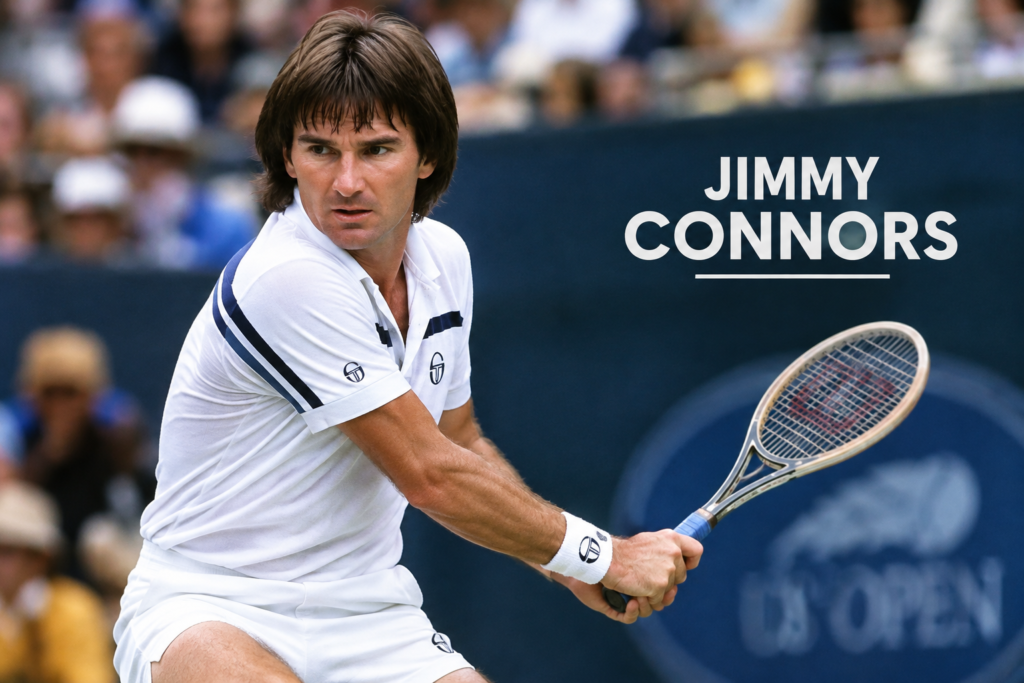

I still remember the first time I watched an old tennis match where Jimmy Connors was playing. The thing that caught my attention wasn’t just his powerful shots. It was his attitude.
He looked like someone who simply refused to lose.
Even when the match became difficult, Connors kept fighting for every point. There was emotion, energy, and a little bit of fire in almost everything he did on the court. That is probably why his name still stands out whenever people talk about the greatest tennis players in history.
Jimmy Connors wasn’t simply a talented tennis player. He became a symbol of determination, competitive spirit, and longevity.
Who Is Jimmy Connors?
Jimmy Connors is a legendary American tennis player who became one of the biggest stars of professional tennis during the 1970s and 1980s.
Born on September 2, 1952, in East St. Louis, Illinois, Connors grew up around tennis. His mother, Gloria, played an important role in developing his skills and encouraged him to take the sport seriously.
Connors eventually became known for his aggressive style, two-handed backhand, powerful returns, and incredible fighting spirit.
What I find most interesting about his career is how long he remained competitive. Tennis is physically demanding, and professional players often have relatively short periods at the very top. Connors managed to stay relevant for decades.
Jimmy Connors and His Rise to Tennis Stardom
Connors turned professional in the early 1970s and quickly made an impression.
At a time when tennis was becoming increasingly popular around the world, he brought a personality that fans could easily recognize. He wasn’t afraid to show emotion, celebrate big points, or challenge opponents.
That made his matches exciting.
His First Grand Slam Success
One of the biggest moments of Connors’ career came at the 1974 US Open, where he won the men’s singles title.
That victory was part of an extraordinary period for him.
In 1974, Connors won three Grand Slam singles titles:
- Australian Open
- Wimbledon
- US Open
His dominant season helped establish him as one of the best players in the world.
The French Open was the one major singles title that he never managed to win.
The Playing Style That Made Connors Special
If you watch footage of Jimmy Connors, one thing becomes obvious very quickly: he loved taking the ball early.
He wasn’t the kind of player who wanted to sit far behind the baseline and patiently wait for an opponent to make mistakes.
Instead, Connors often attacked the ball aggressively.
His two-handed backhand became one of his signature weapons. He also had an exceptional return of serve, which allowed him to put pressure on opponents immediately.
Why His Two-Handed Backhand Stood Out
Connors helped popularize the two-handed backhand during an era when many male players still relied heavily on one-handed backhands.
His version was compact, fast, and difficult to handle.
He could redirect the ball with tremendous pace, especially when returning serve.
For me, this is one of the most interesting lessons from watching Connors: technique doesn’t always have to look complicated. Sometimes a simple movement performed with confidence and timing can be incredibly effective.
Jimmy Connors’ Rivalries
Great tennis careers are often shaped by rivalries, and Connors had plenty of them.
He competed against some of the most memorable players of his generation, including Björn Borg, John McEnroe, Ivan Lendl, and others.
These matches weren’t only about rankings.
They had personality.
Connors vs. John McEnroe
The rivalry between Jimmy Connors and John McEnroe is particularly memorable.
Both players were emotional and extremely competitive, but they expressed themselves differently. Their matches often had an electric atmosphere.
Watching them compete reminds me that sports become much more interesting when two strong personalities meet.
Connors vs. Björn Borg
Connors also had a fascinating rivalry with Björn Borg.
Borg was known for his calm, controlled personality, while Connors was much more expressive. Their contrasting styles created a fascinating matchup.
One player seemed almost ice-cold.
The other looked ready to fight for every single ball.
A Career Built on Longevity
One of Jimmy Connors’ greatest achievements was his ability to keep competing at a high level for so many years.
He won eight Grand Slam singles titles during his career:
- Australian Open – 1974
- Wimbledon – 1974
- US Open – 1974
- US Open – 1976
- US Open – 1978
- Wimbledon – 1982
- US Open – 1982
- US Open – 1983
His success at the US Open was particularly impressive.
Connors won the tournament five times, showing just how comfortable he was competing on hard courts.
What I Learned From Watching Jimmy Connors
Whenever I watch old sports footage, I try to look beyond the final score. With Connors, there are a couple of lessons that stand out to me.
Never Give Away a Point Mentally
Connors had an incredible ability to keep competing even when things weren’t going his way.
That doesn’t mean he won every match. Nobody does.
But his body language often showed that he believed the next point mattered.
I’ve found this useful outside sports too. When something goes wrong, it is easy to mentally give up before the situation is actually finished.
Connors is a great reminder to stay in the fight.
Make Your Strengths Count
Another lesson I take from Connors is the importance of knowing your strengths.
He didn’t try to become a completely different player. He built his game around his aggressive returning, fast backhand, movement, and competitiveness.
That’s something I try to remember in everyday work as well. Improving weaknesses matters, but knowing what you’re already good at can be just as valuable.
Jimmy Connors and His US Open Legacy
When people discuss the greatest US Open players, Connors deserves to be part of the conversation.
His five singles titles at the tournament demonstrate remarkable consistency across different stages of his career.
Perhaps even more impressive was his 1991 run.
At age 39, Connors reached the US Open semifinals, producing one of the most memorable late-career performances in tennis history.
He defeated several younger players along the way and showed that experience and determination could still compete with youth.
That run tells you a lot about Jimmy Connors.
He wasn’t interested in simply becoming a former champion.
He wanted to keep competing.
Life Beyond Professional Tennis
After his playing career, Connors remained connected to tennis through coaching, commentary, appearances, and other activities.
His influence also continued through the generations of players who came after him.
Modern tennis is very different from the game Connors played. Equipment, training, fitness, and tactics have all changed dramatically.
Yet some qualities never become outdated.
Hard work doesn’t become outdated.
Mental toughness doesn’t become outdated.
And the desire to compete certainly doesn’t.
Why Jimmy Connors Still Matters
There are plenty of talented tennis players.
There are also plenty of champions.
But only a small number become genuine characters of their sport.
Jimmy Connors belongs in that group.
His statistics tell part of the story, but they don’t explain everything. To understand his legacy, you have to see the emotion he brought to matches and the intensity with which he competed.
He made people care about what happened on the court.
That is a powerful thing for an athlete to accomplish.
Final Thoughts on Jimmy Connors
When I think about Jimmy Connors, I don’t just think about eight Grand Slam titles or five US Open victories.
I think about a player who competed as though every match mattered.
His career showed that success isn’t only about natural talent. It is also about preparation, confidence, resilience, and the willingness to keep pushing when things become uncomfortable.
For anyone interested in tennis legends, Connors remains one of the most fascinating players to study.