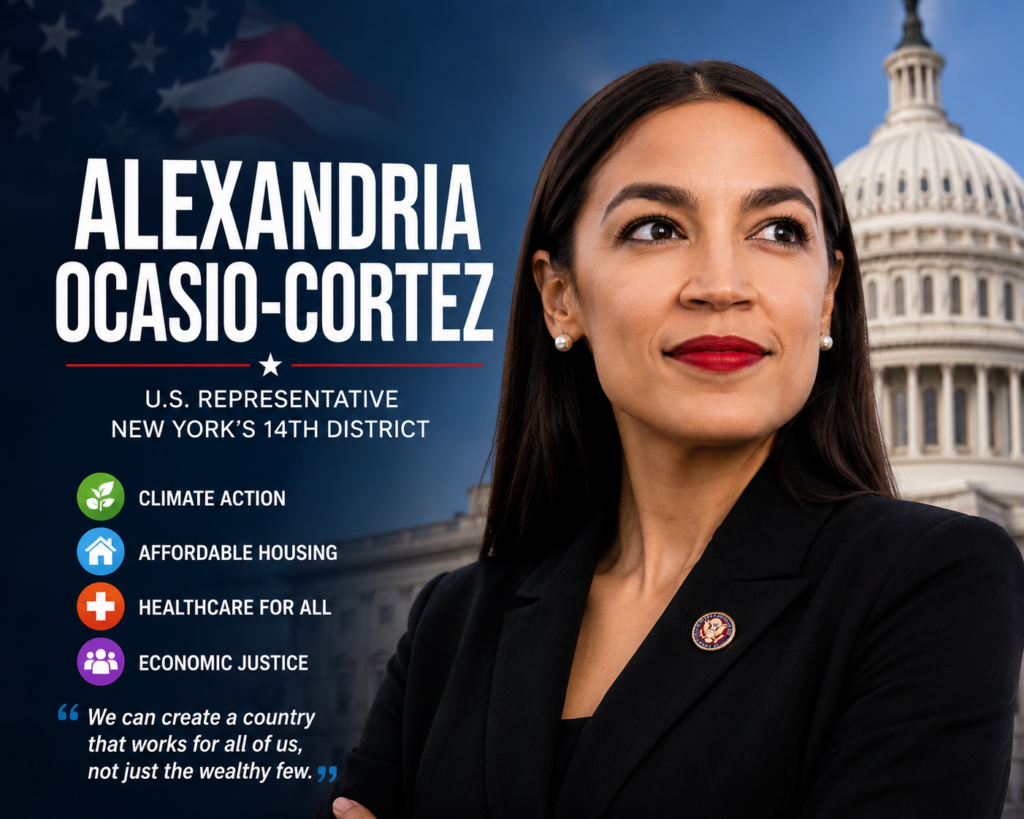

The first time I really started paying attention to Alexandria Ocasio-Cortez, I was struck by how quickly her name had become part of the national conversation. She seemed to appear everywhere at once—on television, social media, congressional hearings, and political debates.
But when you look past the headlines, her story is more interesting than a simple rise-to-fame narrative.
Alexandria Ocasio-Cortez, often called AOC, built her political career around grassroots organizing, progressive policies, and direct communication with voters. Since entering Congress in 2019, she has become one of the most recognizable younger figures in American politics.
As of 2026, she represents New York’s 14th Congressional District and serves on the House Committee on Energy and Commerce, including its Energy, Health, and Oversight and Investigations subcommittees.
Who Is Alexandria Ocasio-Cortez?
Alexandria Ocasio-Cortez is a Democratic member of the U.S. House of Representatives from New York.
She was born in the Bronx on October 13, 1989, and grew up in a family with Puerto Rican roots. Before becoming a member of Congress, she worked in areas outside traditional politics, including community organizing and service work.
That background became an important part of her political identity.
Rather than presenting herself as someone who had spent decades climbing through political institutions, she emphasized her experience with ordinary working people and grassroots communities.
Alexandria Ocasio-Cortez at a Glance
- Full name: Alexandria Ocasio-Cortez
- Known as: AOC
- Born: October 13, 1989
- Birthplace: Bronx, New York
- Political party: Democratic Party
- District: New York’s 14th Congressional District
- First elected: 2018
- Entered Congress: January 2019
- Education: Boston University
- Current committee: House Committee on Energy and Commerce
- Key interests: Climate policy, healthcare, housing, labor, economic inequality, and government oversight
The U.S. House Clerk currently lists her as the Democratic representative for New York’s 14th District.
Alexandria Ocasio-Cortez’s Early Life and Education
Growing up in New York gave Ocasio-Cortez an early connection to the issues affecting large urban communities.
She attended Yorktown High School before studying at Boston University. During and after college, she became increasingly involved in political and community organizing.
One thing I find interesting about this part of her story is that her political career didn’t begin with an obvious path toward Congress.
She spent time working outside elected government, gaining experience talking with people directly and organizing around community issues.
That experience later became central to the way she campaigned.
The 2018 Election That Changed Everything
For me, the most fascinating chapter of Ocasio-Cortez’s story is her 2018 congressional campaign.
She challenged longtime Democratic congressman Joe Crowley in the Democratic primary for New York’s 14th Congressional District.
At the time, Crowley was a well-established political figure. Ocasio-Cortez, by comparison, was a relatively young candidate running a grassroots campaign.
She won the primary.
That victory immediately attracted national attention and became one of the most talked-about political upsets of the 2018 election cycle.
She subsequently won the general election and took office in January 2019.
Why Her Campaign Was Different
Her campaign showed how powerful grassroots organizing could become when combined with modern digital communication.
She relied heavily on volunteers, small-dollar donations, social media, and direct conversations with voters.
My personal tip when researching political campaigns is to look beyond the final vote totals. The campaign strategy often tells you much more about why a candidate succeeds.
In Ocasio-Cortez’s case, the combination of grassroots activism and social media helped her reach voters without depending entirely on traditional political machinery.
Her Political Identity
Ocasio-Cortez is generally associated with the progressive wing of the Democratic Party.
Her political priorities have included:
- Climate change
- Affordable housing
- Healthcare access
- Workers’ rights
- Economic inequality
- Consumer protection
- Environmental justice
- Government accountability
She is also a member of several congressional caucuses, including the Congressional Progressive Caucus, Congressional Hispanic Caucus, Democratic Women’s Caucus, Congressional Labor Caucus, Congressional Renters Caucus, and Sustainable Energy & Environment Coalition.
This helps explain why she frequently appears in debates involving economic, environmental, and social policy.
Alexandria Ocasio-Cortez and the Green New Deal
If there is one policy proposal most closely connected with Alexandria Ocasio-Cortez, it is the Green New Deal.
In February 2019, Ocasio-Cortez introduced H.Res. 109, a resolution recognizing the federal government’s responsibility to create a Green New Deal. Senator Ed Markey introduced the Senate version.
The proposal connected climate action with employment, infrastructure, economic security, and environmental justice.
It called for major reductions in greenhouse gas emissions while also focusing on jobs and economic opportunity.
The resolution itself was not enacted into law. Congress.gov records show that it was introduced in February 2019 and referred to committees for consideration.
Why the Green New Deal Became So Important
The proposal turned Ocasio-Cortez into one of the most recognizable voices in America’s climate-policy debate.
Supporters considered it an ambitious response to climate change.
Critics argued that its goals were unrealistic or too expensive.
Regardless of where someone stands politically, the proposal clearly changed the national conversation about climate policy.
That’s an important lesson I take from her career: sometimes a political proposal can influence public debate even when it doesn’t become law.
Alexandria Ocasio-Cortez and Economic Issues
Economic inequality has remained another major theme throughout her political career.
Ocasio-Cortez frequently talks about wages, living costs, housing, healthcare, and workers’ rights.
These issues are particularly relatable because they affect ordinary household decisions.
When rent rises, groceries become more expensive, or healthcare costs increase, those aren’t just political talking points. They become part of someone’s monthly budget.
That connection between national policy and everyday life is one reason her communication style has attracted such a large audience.
Her Focus on Housing
Housing is another area where Ocasio-Cortez has developed a strong political profile.
She has supported policies aimed at expanding affordable housing and improving public housing.
In 2019, she introduced the Green New Deal for Public Housing Act, which connected public-housing modernization with energy efficiency, economic opportunity, and workforce development. Congress.gov lists the bill as having been introduced in November 2019 and referred to the House Financial Services Committee.
Housing remains especially important in New York, where affordability is a major concern for many residents.
Her Work in Congress Today
One thing that can get lost in celebrity-style political coverage is the actual committee work done by members of Congress.
Ocasio-Cortez currently serves on the House Committee on Energy and Commerce. She joined the committee in January 2025 and was appointed to its Energy, Health, and Oversight and Investigations subcommittees.
The committee covers a huge range of issues, including energy, healthcare, technology, communications, consumer protection, and other areas that directly affect American households.
Her current committee assignments therefore give her a role in debates that go far beyond climate policy.
Why Committee Work Matters
I’ve found that committee assignments are one of the easiest ways to understand what a member of Congress is actually working on.
A representative can make headlines on social media, but committees are where much of the detailed legislative work takes place.
For Ocasio-Cortez, Energy and Commerce places her in the middle of discussions about energy policy, healthcare, technology, and government oversight.
Her Communication Style
Another major reason Alexandria Ocasio-Cortez has become so recognizable is her communication style.
She has used social media extensively to explain political issues, respond to critics, discuss legislation, and communicate directly with supporters.
This is different from the older model of political communication, where voters often depended on newspapers, television interviews, and campaign advertisements.
Today, a politician can speak directly to millions of people through a smartphone.
My second personal tip for anyone studying her career is simple: pay attention to how she explains an issue, not just what position she takes.
Even people who disagree with her can learn something about modern political communication by watching how she turns complicated subjects into accessible conversations.
Why She Has So Many Supporters—and Critics
Ocasio-Cortez is a polarizing political figure.
Her supporters often praise her for being outspoken, progressive, and willing to challenge established political norms.
Her critics strongly disagree with some of her policies and political positions.
That contrast is part of what makes her such an interesting public figure.
She has rarely tried to become invisible. Instead, she has embraced a highly public role and frequently participates in contentious national debates.
In politics, visibility can be both an advantage and a disadvantage.
What Could Come Next?
This is where the story becomes especially interesting.
As of August 2026, Ocasio-Cortez has not ruled out possible future political ambitions, including a potential presidential run or a challenge for the U.S. Senate. Recent reporting says she has kept those options open while emphasizing the importance of the upcoming midterm elections.
That doesn’t mean she has announced a 2028 campaign.
It simply means that her political future remains an open question.
And honestly, that’s probably one of the most interesting things about her career right now.
Two Lessons From Alexandria Ocasio-Cortez’s Career
Looking at her journey, I think there are two practical lessons worth remembering.
1. Don’t underestimate grassroots support
Her 2018 campaign showed that a candidate without decades of political experience can challenge an established incumbent with strong grassroots organization.
Building genuine relationships with supporters can be incredibly powerful.
2. Learn to communicate clearly
Ocasio-Cortez has built a recognizable public voice.
Whether you agree with her or not, she knows how to make political topics understandable to a broad audience.
For anyone working in marketing, content creation, or public communication, I think that’s worth studying.
Alexandria Ocasio-Cortez’s Lasting Influence
At this point, Ocasio-Cortez has become much more than a single congressional candidate who won an unexpected primary.
Her career represents several broader changes in American politics:
- The growing influence of grassroots campaigns
- The importance of social media
- Greater attention to younger voters
- Increased discussion of climate policy
- More focus on economic inequality
- The changing role of women and minorities in national politics
- A stronger connection between online communities and political campaigns
Her influence will ultimately be measured by more than individual elections.
It will also be measured by how much her ideas affect the Democratic Party and the broader political conversation.
Final Thoughts on Alexandria Ocasio-Cortez
When I look at Alexandria Ocasio-Cortez, I don’t think the most interesting part of her story is simply that she became famous.
It’s how she got there.
She started with community organizing, launched an unexpected congressional campaign, defeated an established incumbent in a primary, and entered Congress in 2019. Since then, she has remained one of the most visible progressive voices in American politics.
Her work on the Green New Deal helped make climate policy a national political issue, while her focus on housing, healthcare, workers, and economic inequality has kept her closely connected to the concerns of many working Americans.