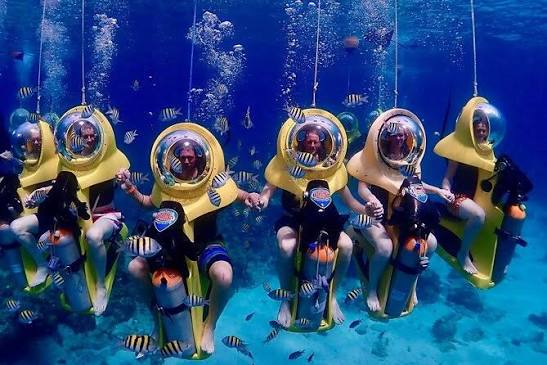

The first time I saw an underwater scooter in action, I honestly thought it looked like something from a science-fiction movie. A swimmer held onto a small motorized device, pressed a button, and suddenly glided through the water without kicking hard.
That got me curious.
After learning more about underwater scooters, I realized they are not just fun gadgets. They can make snorkeling, diving, and underwater exploration feel completely different. Instead of spending all your energy swimming forward, you can let the scooter do much of the work while you focus on what is around you.
If you’re considering buying or trying one, this guide will help you understand how an underwater scooter works, what to look for, where you can use one, and what I would keep in mind before getting started.
What Is an Underwater Scooter?
An underwater scooter is a compact, battery-powered device designed to pull a swimmer or diver through the water.
Most models have a motor, propeller, battery, handles, and controls. You hold onto the handles and use the controls to move forward. Some models are designed mainly for recreational snorkeling, while more powerful versions are intended for scuba diving.
You may also hear them called:
- Underwater sea scooter
- Diver propulsion vehicle
- Underwater propulsion scooter
- Snorkeling scooter
- DPV
The basic idea is wonderfully simple: instead of constantly kicking your legs to move, the motor provides propulsion.
How Does an Underwater Scooter Work?
The technology isn’t particularly complicated from a user’s perspective.
A rechargeable battery powers an electric motor. The motor turns a propeller, and the propeller pushes water backward. That creates forward movement.
Depending on the model, you may have different speed settings. Some recreational scooters are relatively gentle, while advanced diving scooters can provide considerably more thrust.
What You Usually Get
An underwater scooter commonly includes:
- Electric motor – Provides the power needed for movement.
- Propeller – Pushes water and creates forward thrust.
- Rechargeable battery – Supplies energy to the motor.
- Handles – Give you control and stability.
- Trigger or button controls – Used to activate the motor.
- Safety features – Some models include protective propeller guards or automatic shutoff systems.
The exact specifications vary considerably, so I wouldn’t choose one simply because it looks powerful.
Why Use an Underwater Scooter?
For me, the biggest attraction is convenience.
Swimming for a long time can become tiring, especially if you’re wearing snorkeling equipment or diving gear. A scooter can reduce the amount of physical effort required to cover the same distance.
It can also make underwater exploration more enjoyable.
Explore More With Less Effort
Instead of spending most of your attention on kicking, you can concentrate on your surroundings.
That can be particularly enjoyable when snorkeling around reefs, rocky areas, or other interesting underwater environments.
It’s Fun
Let’s be honest—there’s also a fun factor.
Gliding underwater with a small motorized scooter feels completely different from ordinary swimming. It can turn a normal snorkeling session into something you’ll remember.
Cover More Water
An underwater scooter can help you travel farther during a session, depending on battery capacity, speed, water conditions, and your equipment.
However, I always think it’s better to plan conservatively rather than trying to push the scooter to its maximum range.
Choosing the Right Underwater Scooter
This is where I recommend slowing down.
There are plenty of models available, but they aren’t all designed for the same purpose. A casual snorkeler doesn’t necessarily need the same machine as someone doing serious scuba diving.
Here are the features I’d compare first.
Battery Life
Battery capacity is one of the most important specifications.
A scooter might have impressive speed, but if the battery doesn’t last long enough for your planned activity, that speed doesn’t help much.
Look at the manufacturer’s stated runtime and remember that actual performance can vary depending on speed, water conditions, user weight, and other factors.
Speed
More speed isn’t automatically better.
If you’re snorkeling casually, a moderate speed may be more comfortable and easier to control. Experienced divers may want greater thrust, especially when carrying heavier equipment.
Think about where and how you’ll actually use the scooter.
Weight
This is an easy feature to overlook.
A scooter that feels manageable in a store or on land can feel very different when you’re carrying other equipment or transporting it to the water.
I personally prefer equipment that I can handle comfortably rather than choosing something simply because it has the highest specifications.
Depth Rating
Always check the manufacturer’s depth rating.
Some recreational underwater scooters are intended for relatively shallow use, while diving-oriented models can be designed for much greater depths.
Never assume that a waterproof scooter is automatically suitable for deep diving.
My Personal Tips for Using an Underwater Scooter
If you’re trying an underwater scooter for the first time, I’d keep things simple.
Tip #1: Practice in Calm, Shallow Water
My first recommendation is to become comfortable with the controls before heading into deeper water.
Practice starting, stopping, turning, and releasing the controls. You want those movements to become familiar.
Don’t make your first attempt in strong currents.
Start at a Comfortable Speed
It’s tempting to immediately choose the fastest setting.
I’d resist that temptation.
Start slowly and learn how the scooter responds when you turn and stop. Once you’re comfortable, you can gradually increase the speed if conditions and equipment allow it.
Keep an Eye on Your Battery
One mistake beginners can make is focusing so much on the scenery that they forget about battery usage.
I would always leave enough battery capacity to return safely rather than using nearly everything on the outward journey.
Underwater Scooter Safety
Fun should never come before safety.
Before using an underwater scooter, read the manufacturer’s instructions and understand its operating limits.
Here are some basic precautions:
- Use appropriate swimming or diving equipment.
- Follow the scooter’s depth and operating limits.
- Check the battery and housing before entering the water.
- Inspect the propeller and protective components.
- Avoid areas with dangerous boat traffic.
- Be cautious around coral, marine life, swimmers, and other obstacles.
- Don’t use the scooter in conditions beyond your experience level.
- Keep sufficient battery power for your return.
- Follow local water-sports and diving regulations.
If you’re scuba diving, remember that an underwater scooter doesn’t replace proper diving training or safe diving practices.
A diver should also understand how propulsion affects buoyancy, air consumption, navigation, and distance from the entry point.
Underwater Scooter vs. Traditional Snorkeling
So, is a scooter actually better than normal snorkeling?
I’d say it depends on what you want.
Traditional snorkeling is simple. You need relatively little equipment, and you can move at your own pace.
An underwater scooter adds speed and reduces kicking effort, but it also introduces another piece of equipment that needs charging, maintenance, transportation, and safe operation.
Traditional Snorkeling
Advantages:
- Simple setup
- Lightweight
- No motor or battery
- Easy to stop whenever you want
- Usually more affordable
Underwater Scooter
Advantages:
- Less kicking effort
- Faster underwater movement
- Can make exploration more exciting
- Useful for covering greater distances
For a relaxed beach vacation, basic snorkeling equipment may be all you need. For someone who regularly enjoys underwater exploration, a scooter can be a worthwhile addition.
Where Can You Use an Underwater Scooter?
The answer depends heavily on the particular model and local rules.
Some people use recreational scooters while snorkeling in suitable open-water environments. More advanced devices are used by trained divers.
Before taking one into the water, check:
- Whether the scooter is suitable for the environment.
- Its maximum depth rating.
- Local water-sports regulations.
- Any restrictions at the beach, marine park, or diving location.
- Weather and water conditions.
Don’t assume that because a scooter can technically operate somewhere, you’re automatically allowed to use it there.
How to Maintain Your Underwater Scooter
A little maintenance can go a long way.
After use in saltwater, follow the manufacturer’s cleaning instructions carefully. Salt and sand can be tough on equipment if they’re left behind.
I would also inspect the propeller, seals, battery compartment, and exterior regularly.
Store the scooter according to the manufacturer’s recommendations and avoid leaving rechargeable batteries in unsuitable conditions.
Good maintenance isn’t exciting, but it can save you from an unpleasant surprise before your next trip.
Is an Underwater Scooter Worth It?
For the right person, absolutely.
If you love snorkeling, diving, or underwater photography, an underwater scooter can add a completely new dimension to the experience.
However, I wouldn’t buy one based purely on speed or appearance.
Think about your typical water activities, experience level, transportation needs, battery requirements, depth requirements, and budget.
A well-matched scooter is much more useful than an expensive model with features you’ll never use
Final Thoughts
An underwater scooter can make exploring beneath the surface feel easier, faster, and a lot more exciting. What I like most about the concept is that it lets you spend less energy fighting the water and more time enjoying what’s around you.
Still, the right scooter isn’t necessarily the fastest or most expensive one. Battery life, weight, depth rating, controls, safety features, and intended use all matter.
If you’re new to underwater scooters, start slowly, practice in suitable conditions, and learn your equipment before taking on more challenging environments.