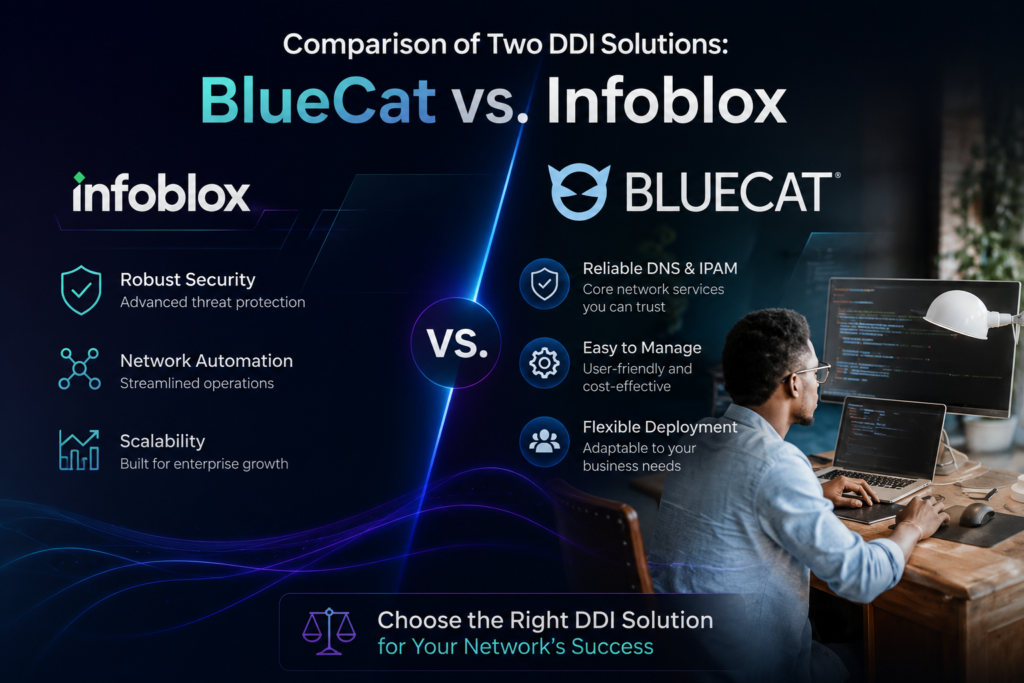

When I first started researching enterprise DDI (DNS, DHCP, and IP Address Management) solutions, I quickly realized that Infoblox vs BlueCat was one of the most common comparisons. Both companies have built strong reputations in the networking industry, and both promise reliable DNS, DHCP, and IP address management. But after spending time learning about their platforms and talking with IT professionals, I discovered that each solution has its own strengths.
If you’re trying to decide between Infoblox and BlueCat, this guide will help you understand the differences in simple terms. Instead of focusing on marketing claims, I’ll explain the features, advantages, and situations where each platform works best.
What Are Infoblox and BlueCat?
Before comparing them, it’s helpful to understand what these platforms actually do.
Both Infoblox and BlueCat provide DDI solutions, which combine three essential network services:
- DNS (Domain Name System)
- DHCP (Dynamic Host Configuration Protocol)
- IP Address Management (IPAM)
These services help organizations manage devices, networks, and IP addresses efficiently while improving security and reducing manual work.
Why Businesses Need DDI Solutions
Managing a few devices is easy, but large businesses often have thousands of computers, servers, mobile devices, printers, and IoT equipment connected to their networks.
A modern DDI platform helps organizations:
- Automate IP address management
- Improve DNS reliability
- Reduce network downtime
- Increase visibility across the network
- Strengthen DNS security
- Simplify network administration
This is why enterprise organizations often compare Infoblox vs BlueCat before investing in a DDI solution.
Infoblox Overview
Infoblox is one of the best-known names in the DDI market. Many large enterprises use it because of its mature platform, automation features, and strong security capabilities.
Some notable strengths include:
Advanced DNS Security
Infoblox places a strong emphasis on DNS security. Organizations can detect suspicious DNS activity and improve protection against cyber threats through its security-focused features.
Automation
One feature I appreciate is its automation capability. Instead of manually assigning IP addresses or updating DNS records, administrators can automate many repetitive tasks.
Enterprise Scalability
Infoblox is designed for large enterprises with complex network environments. It can support organizations operating across multiple offices and data centers.
BlueCat Overview
BlueCat is another respected DDI provider that focuses on flexibility and visibility.
Its platform is often praised for helping organizations modernize network management while supporting hybrid and cloud environments.
Some key strengths include:
Cloud Integration
BlueCat works well in environments that use public cloud services alongside traditional on-premises infrastructure.
Flexible Architecture
Many organizations choose BlueCat because its architecture allows easier customization for different network environments.
Network Visibility
BlueCat provides administrators with detailed visibility into connected devices and IP address usage, making troubleshooting easier.
Infoblox vs BlueCat: Feature Comparison
Let’s compare the two platforms across several important areas.
1. Ease of Management
Both products simplify network management, but their interfaces and workflows differ.
Infoblox offers a mature management platform with extensive administrative controls. It is often preferred by organizations already familiar with enterprise networking tools.
BlueCat focuses on flexibility and automation while providing an interface designed to simplify day-to-day operations.
2. DNS Management
Reliable DNS is essential for modern organizations.
Infoblox offers advanced DNS management with integrated security features that appeal to security-conscious enterprises.
BlueCat also delivers reliable DNS services while emphasizing adaptability across hybrid infrastructures.
3. IP Address Management
IP address management is one of the biggest reasons organizations invest in these platforms.
Both products help administrators:
- Track IP allocations
- Prevent address conflicts
- Monitor available address space
- Automate IP assignments
- Improve reporting
In practical use, both solutions perform well, although the best choice often depends on an organization’s existing infrastructure and operational requirements.
4. Automation Features
Automation has become increasingly important as networks continue growing.
Infoblox includes powerful automation capabilities that reduce manual administrative work.
BlueCat also supports automation and integrates well with modern IT workflows, making it attractive for organizations adopting DevOps practices.
5. Security
Security is one of the biggest decision factors when comparing Infoblox vs BlueCat.
Infoblox is widely recognized for its DNS security capabilities and threat intelligence integrations.
BlueCat also offers security-focused features while concentrating on network visibility and policy management.
Performance and Scalability
Large organizations require DDI solutions that continue performing as networks expand.
Both Infoblox and BlueCat are designed to support enterprise-scale environments. They can manage thousands of devices while maintaining reliable DNS and DHCP services.
Organizations with highly distributed infrastructures should carefully evaluate how each platform integrates with their existing systems, cloud providers, and security tools.
Part 2 will continue with pricing considerations, deployment, cloud support, pros and cons, who should choose each platform, the conclusion, and 5 SEO-friendly FAQs.
Pricing Considerations
One of the first questions most organizations ask is, “Which solution costs less?” The answer isn’t always straightforward. Both Infoblox and BlueCat typically offer customized pricing based on factors such as the size of your network, deployment model, required features, and support level.
Instead of focusing only on the initial cost, I recommend looking at the total cost of ownership. A platform that saves your IT team hours of manual work every week may provide better long-term value, even if the upfront investment is higher.
When comparing pricing, consider:
- Number of managed IP addresses
- DNS and DHCP requirements
- Cloud integration needs
- Security features
- Technical support and maintenance
- Future scalability
Deployment Options
Both platforms support modern deployment options, making them suitable for different IT environments.
Infoblox
Infoblox supports on-premises, virtual, and cloud deployments. This flexibility makes it a good fit for organizations with traditional data centers as well as those moving toward hybrid infrastructure.
BlueCat
BlueCat also supports on-premises and cloud deployments while placing a strong focus on hybrid cloud environments. Many organizations appreciate its ability to integrate with modern cloud platforms and automation tools.
Integration Capabilities
A DDI solution should work smoothly with the rest of your IT infrastructure.
Infoblox integrates with many enterprise networking, security, and automation tools, making it easier to manage large environments from a centralized platform.
BlueCat also provides strong integration options, particularly for organizations that rely on cloud-native technologies, automation, and DevOps workflows.
Before making a decision, it’s worth checking whether the platform integrates with your existing systems, such as:
- Cloud platforms
- Security solutions
- IT service management tools
- Network monitoring software
- Automation frameworks
Pros and Cons
Infoblox Pros
- Mature enterprise DDI platform
- Strong DNS security capabilities
- Reliable automation features
- Excellent scalability for large organizations
- Broad ecosystem of integrations
Infoblox Cons
- May require more planning for deployment in complex environments
- Advanced features may be more than smaller organizations need
BlueCat Pros
- Flexible architecture
- Strong support for hybrid and cloud environments
- Good automation capabilities
- Excellent network visibility
- Modern integration options
BlueCat Cons
- Some advanced features may require additional configuration
- Organizations should evaluate feature availability based on their specific deployment needs
Which Solution Should You Choose?
After comparing Infoblox vs BlueCat, it’s clear that there isn’t a single winner for every organization.
Infoblox may be the better choice if you:
- Need enterprise-grade DNS security
- Manage a large, complex network
- Want a mature DDI platform with extensive automation
- Require strong operational stability
BlueCat may be a better fit if you:
- Are adopting hybrid or multi-cloud infrastructure
- Want greater deployment flexibility
- Value network visibility and automation
- Need a platform that integrates well with modern IT workflows
The best decision ultimately depends on your organization’s size, existing infrastructure, security requirements, and long-term IT strategy.
Final Thoughts
Choosing between Infoblox vs BlueCat isn’t about finding a universally better product—it’s about selecting the solution that aligns with your business goals. Both platforms provide reliable DNS, DHCP, and IP Address Management capabilities, and both have earned strong reputations in the enterprise networking market.
If your priority is advanced DNS security and a well-established enterprise platform, Infoblox is a compelling option. If you’re focused on cloud flexibility, automation, and modern network management, BlueCat deserves serious consideration.
Before making a final decision, take time to evaluate your technical requirements, deployment preferences, integration needs, and future growth plans. A well-informed choice today can make network management simpler and more efficient for years to come.
Also read :: https://techylifes.co.uk/nearest-public-phone/