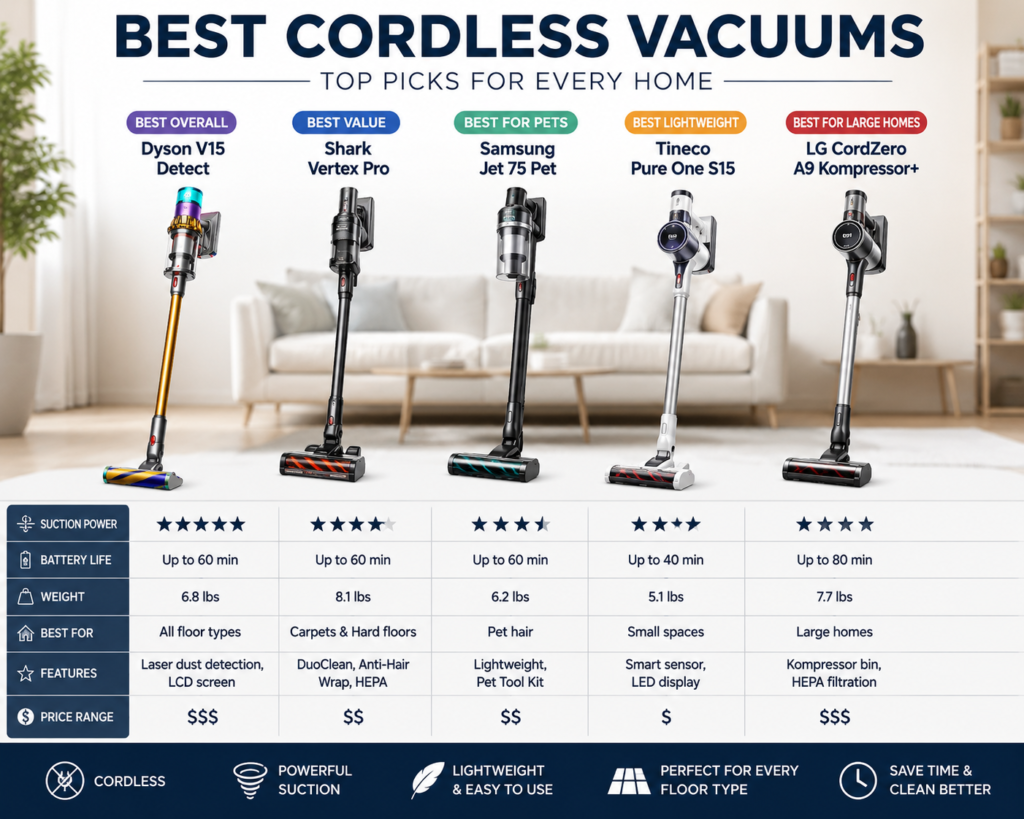

The first time I used a cordless vacuum, I honestly wondered why I had waited so long. I had just finished dinner, noticed crumbs scattered across the kitchen floor, and knew I wasn’t going to drag out a full-size vacuum for five minutes of cleaning.
I grabbed a cordless model, pressed the button, and was done before I had time to change my mind.
That little experience changed the way I thought about cleaning. A good cordless vacuum isn’t just about replacing a traditional vacuum. It’s about making quick cleaning feel less like a chore.
If you’re searching for the best cordless vacuums, you’ll quickly discover that there are countless options. Some are designed for powerful carpet cleaning, others are better for hardwood floors, and some are surprisingly good at handling pet hair.
I’ve learned that the “best” vacuum isn’t necessarily the most expensive one. It is the one that matches your home, cleaning habits, floors, and budget.
What Makes the Best Cordless Vacuums Worth Buying?
A cordless vacuum has one obvious advantage: freedom.
There is no power cable to unplug and reconnect as you move from room to room. You can clean stairs, cars, kitchens, bedrooms, and small messes without thinking about where the nearest outlet is.
But convenience isn’t enough. A good cordless vacuum should also offer:
- Strong suction
- Useful battery life
- Comfortable handling
- A practical dustbin
- Easy-to-clean filters
- Helpful attachments
- Good performance on your type of flooring
- Reasonable charging time
I always recommend looking at the complete package rather than focusing on a single specification.
A vacuum can have impressive suction but still be annoying to use if it is heavy or has a tiny dustbin.
Best Cordless Vacuums for Different Homes
There isn’t one vacuum that is perfect for everybody.
A person living in a small apartment may prioritize lightweight design and storage. Someone with several pets may care much more about powerful suction and a motorized pet brush.
Here are some common situations to consider.
Best for Small Apartments
If you live in a smaller home, you probably don’t need a huge machine.
I’d look for a lightweight cordless vacuum that can easily move between rooms and fit inside a closet. A wall-mounted charging dock can also be useful when storage space is limited.
For quick daily cleaning, battery capacity doesn’t need to be enormous. What matters more is that the vacuum is always ready when you need it.
Best for Homes With Pets
Pet hair changes everything.
I’ve found that ordinary suction isn’t always enough when hair gets tangled into carpets, rugs, and furniture. A motorized brush designed for pet hair can make a noticeable difference.
If you have dogs or cats, look for features such as:
- Anti-tangle brush technology
- Strong suction
- Motorized upholstery tools
- Easy-to-empty dustbins
- Washable or replaceable filters
And don’t forget the furniture. A vacuum that works well on floors but struggles with sofas isn’t particularly useful in a pet-friendly home.
Best for Hardwood Floors
Hardwood and other hard surfaces don’t always require maximum suction.
Instead, I prefer a vacuum with a soft roller or floor head that can pick up dust and crumbs without being unnecessarily aggressive on delicate surfaces.
A good hard-floor vacuum should also make it easy to clean around furniture legs and along baseboards.
Battery Life Matters More Than You Think
One of the biggest differences between cordless and corded vacuums is battery management.
Manufacturers often advertise a maximum runtime, but that number can vary considerably depending on the cleaning mode and attachment you’re using.
For example, an economy setting may provide much longer runtime than the highest-power setting.
When comparing cordless vacuum batteries, consider:
- Total runtime
- Charging time
- Whether the battery is removable
- Availability of replacement batteries
- Runtime in high-power mode
My personal tip is simple: don’t choose a vacuum based only on the biggest runtime number you see.
Think about how you actually clean.
If you usually do a 10-minute cleanup every day, a vacuum with a moderate runtime may be perfectly adequate.
Suction Power Isn’t Everything
This is one of the easiest things to misunderstand when shopping for a vacuum.
A high suction rating sounds impressive, but real-world cleaning performance depends on several factors.
The brush design, airflow, floor head, filtration system, and ability to maintain suction as the dustbin fills can all affect results.
I’ve used cleaning equipment where the specifications looked excellent on paper but the actual experience was disappointing.
That’s why I prefer looking at the whole cleaning system rather than chasing one impressive number.
Weight and Comfort Can Make or Break Your Experience
Imagine holding a vacuum above your head to clean a ceiling corner.
Now imagine doing it for several minutes.
Suddenly, weight matters.
A lightweight vacuum can be much easier to use on stairs, curtains, shelves, furniture, and high surfaces. Even a difference that seems small on paper can become noticeable during longer cleaning sessions.
I recommend paying attention to:
- Handle design
- Overall weight
- Balance
- Trigger or power-button placement
- Ease of steering
- One-handed operation
My second personal tip is to think about where you will use the vacuum, not just where you will store it.
A vacuum that feels comfortable on the floor might feel completely different when you’re cleaning stairs or furniture.
Filtration and Dust Management
A vacuum’s filtration system doesn’t get as much attention as suction, but it should.
Good filtration helps keep fine dust contained rather than simply pushing it back into the room.
If someone in your household is particularly sensitive to dust, I’d pay close attention to the filtration design and maintenance requirements.
A washable filter can also save money over time, provided the manufacturer allows it to be washed.
Don’t Ignore the Dustbin
A cordless vacuum with a tiny dustbin can become frustrating quickly.
If you’re constantly stopping to empty it, the convenience disappears.
For a smaller apartment, a compact dustbin may be perfectly acceptable. Larger homes or households with pets may benefit from greater capacity.
Attachments You Should Actually Care About
Some cordless vacuums come with a drawer full of accessories.
That’s great until you realize you only use two of them.
For everyday cleaning, I think the most useful attachments are usually:
- Crevice tool
- Dusting brush
- Motorized upholstery tool
- Combination cleaning tool
- Flexible or extension attachment
A good crevice tool is particularly useful for getting into corners, around furniture, and between car seats.
I would rather have five genuinely useful attachments than fifteen accessories that stay in the box.
Cordless Vacuum Maintenance
Even the best cordless vacuums need basic maintenance.
Fortunately, most of it is straightforward.
A Simple Maintenance Routine
- Empty the dustbin regularly.
- Check the brush roll for hair and threads.
- Clean washable filters according to the manufacturer’s instructions.
- Keep the charging area free from dust.
- Inspect attachments occasionally for blockages.
- Replace filters or batteries when required.
I especially recommend checking the brush roll if you have long hair or pets.
Hair can wrap around the roller surprisingly quickly, and a blocked brush can affect cleaning performance.
Are Cordless Vacuums Worth It?
For many households, absolutely.
The biggest advantage isn’t necessarily raw power. It’s convenience.
When a vacuum is sitting on a charging dock and ready to go, you’re more likely to use it for small messes.
That’s important because cleaning a little every day can be much easier than allowing crumbs, dust, and pet hair to build up until you need a major cleaning session.
However, I wouldn’t automatically replace a powerful full-size vacuum with a cordless model.
If you have thick carpets, a large home, or need long uninterrupted cleaning sessions, a corded or full-size vacuum may still make sense.
For many people, the ideal setup is actually both: a cordless vacuum for everyday cleaning and a larger vacuum for deeper cleaning.
How I Would Choose a Cordless Vacuum
If I were buying one today, I’d follow this simple process:
1. Look at Your Flooring
Do you have hardwood, tile, carpet, rugs, or a mixture?
Your flooring should influence the type of floor head you choose.
2. Consider Your Home Size
A small apartment and a large house have very different battery requirements.
3. Think About Pets
If you have pets, prioritize hair pickup, brush design, and filtration.
4. Check the Weight
Don’t underestimate comfort.
5. Look at Replacement Parts
Batteries, filters, rollers, and other replacement components matter for long-term ownership.
6. Set a Realistic Budget
Don’t pay extra for features you’ll never use.
The best purchase is one that solves your cleaning problems without adding unnecessary complexity.
Final Thoughts on the Best Cordless Vacuums
Finding the best cordless vacuums is less about choosing the machine with the longest feature list and more about understanding what you actually need.
For quick everyday messes, a lightweight model with good suction and a useful battery can be incredibly convenient. For pet owners, specialized brushes and filtration become more important. For larger homes, battery life and replaceable batteries deserve extra attention.
My biggest advice is to think about your real cleaning routine before buying. Ask yourself where you’ll use the vacuum, how often you’ll use it, what kind of floors you have, and whether you’ll need to clean pet hair or furniture.