
I still remember watching old NBA highlights and wondering how some coaches managed to control a locker room full of superstar personalities. Then I came across Phil Jackson. What stood out to me wasn’t just the championship rings. It was the way he seemed to understand people as much as he understood basketball.
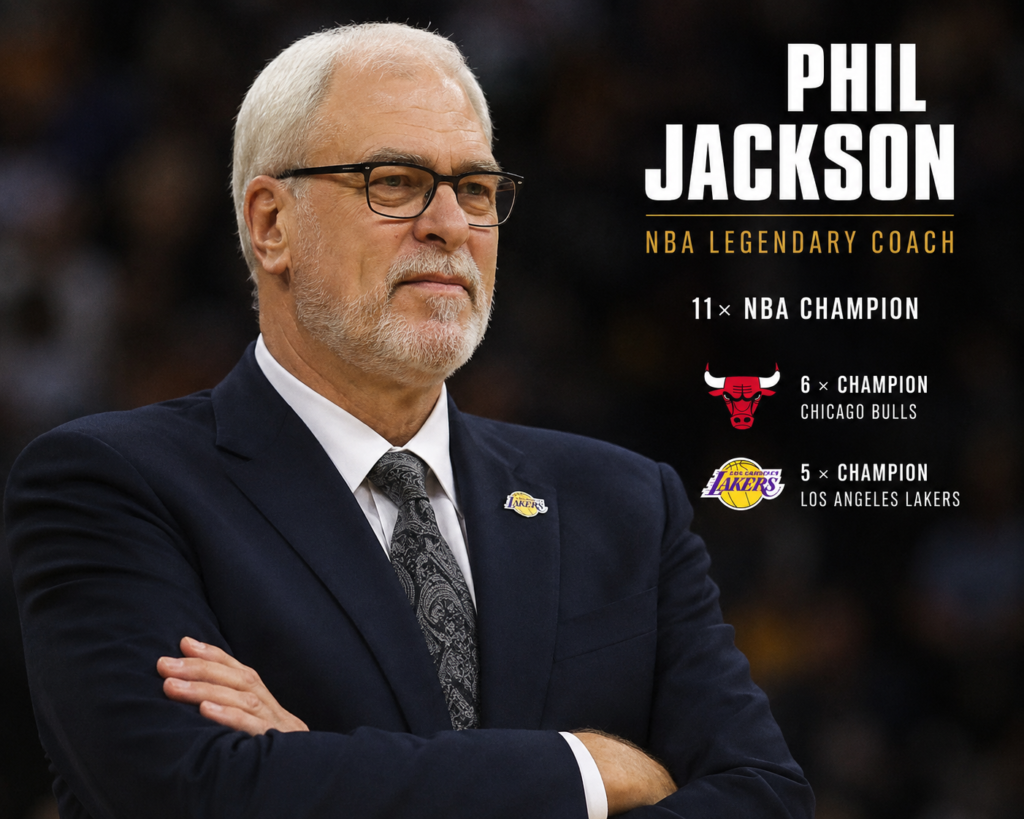
Phil Jackson became one of the most successful coaches in NBA history by leading the Chicago Bulls and Los Angeles Lakers to a combined 11 NBA championships. He coached legends such as Michael Jordan, Scottie Pippen, Shaquille O’Neal, and Kobe Bryant, while developing a unique approach built around teamwork, patience, confidence, and his famous triangle offense.
For me, that’s what makes the story of Phil Jackson so interesting. His career wasn’t simply about drawing plays on a whiteboard. It was about getting talented people to work together.
Who Is Phil Jackson?
Phil Jackson was born on September 17, 1945, in Deer Lodge, Montana. He eventually became an NBA player, coach, and one of the most recognizable basketball minds in the world. The Naismith Basketball Hall of Fame inducted him in 2007.
Before becoming a legendary coach, Jackson spent 12 years playing professional basketball. He played primarily for the New York Knicks and later the New Jersey Nets, averaging 6.7 points and 4.3 rebounds over 807 NBA games.
Interestingly, Jackson also experienced championship success as a player. He was part of the Knicks teams that won NBA championships in 1970 and 1973.
That playing experience became important later. Jackson understood what it felt like to sit on the bench, deal with coaches, compete for minutes, and play alongside talented teammates.
Phil Jackson’s Journey From Player to Coach
Jackson’s transition into coaching wasn’t an overnight success story.
He worked his way through different levels of basketball, including coaching the Albany Patroons in the Continental Basketball Association. He won a CBA championship with Albany in 1984 before eventually joining the Chicago Bulls organization as an assistant coach.
In 1989, Jackson became the Bulls’ head coach.
That decision changed NBA history.
The Chicago Bulls Era
When Phil Jackson took over the Bulls, Michael Jordan was already becoming a superstar. But the challenge was turning Jordan’s individual brilliance into consistent team success.
Jackson helped create an environment where Jordan could dominate without having to do everything himself.
The Bulls won six NBA championships under Jackson:
- 1991
- 1992
- 1993
- 1996
- 1997
- 1998
Jackson coached Chicago for nine seasons and became an important figure in one of the greatest dynasties in sports history.
One of the most impressive seasons came in 1995-96. The Bulls finished the regular season 72-10, an extraordinary record at the time, and Jackson was named NBA Coach of the Year.
When I look at that team today, one lesson stands out: having the best player isn’t enough. You need a system that allows everyone around that player to contribute.
The Triangle Offense
One of the biggest parts of Phil Jackson’s coaching philosophy was the triangle offense.
The system was heavily associated with assistant coach Tex Winter, whose basketball ideas became a foundation of the championship Bulls and Lakers teams.
Instead of relying on one player to create every possession, the triangle emphasized spacing, movement, passing, decision-making, and reading the defense.
That sounds simple when explained, but executing it at an NBA level required tremendous discipline.
Why the Triangle Worked
The triangle offense gave talented players structure without completely taking away their freedom.
Players had to read what was happening instead of simply memorizing a sequence of moves.
That philosophy fit Jackson’s coaching personality perfectly. He trusted players to make decisions and encouraged them to understand the game rather than constantly waiting for instructions from the sideline.
Phil Jackson and the Los Angeles Lakers
After leaving Chicago, Jackson took a break before returning to coaching with the Los Angeles Lakers for the 1999-2000 season.
This time, the challenge was different.
The Lakers had Shaquille O’Neal and Kobe Bryant, two extraordinary talents with very different personalities and playing styles.
Jackson helped turn that combination into another dynasty.
The Lakers won three consecutive championships in 2000, 2001, and 2002. After Jackson returned to the Lakers later in the decade, he added two more championships in 2009 and 2010.
That gave Jackson five championships with Los Angeles and six with Chicago.
Managing Shaq and Kobe
One of the reasons I find Phil Jackson’s coaching career fascinating is the number of personalities he had to manage.
Shaquille O’Neal was one of the most dominant centers ever. Kobe Bryant was intensely competitive and determined to become one of the greatest players in basketball.
Keeping those personalities focused on the same goal wasn’t easy.
Jackson’s ability to give stars room to be themselves while still emphasizing the team’s bigger objective became one of his defining strengths. NBA.com has highlighted his ability to manage superstar personalities and build championship teams around them.
What Made Phil Jackson Different?
Phil Jackson wasn’t the loudest coach on the sideline. His approach was often more psychological and philosophical.
He drew inspiration from Eastern philosophy and Native American traditions, which contributed to his reputation as the “Zen Master.” The Hall of Fame describes him as an intellectual, spiritualist, maverick, athlete, and coach.
Some of his methods were unconventional.
He wanted players to think about the present moment. He encouraged them to understand themselves and their teammates. He also believed that giving players responsibility could help them become more confident.
For me, this is one of the most useful lessons from Jackson’s career: leadership isn’t always about talking the most. Sometimes it’s about knowing when to step back.
Phil Jackson’s Coaching Record
The numbers behind Jackson’s career are remarkable.
According to NBA.com, Jackson finished his NBA coaching career with a 1,155-485 regular-season record, a .704 winning percentage, and 11 championships.
His major coaching achievements include:
- 11 NBA championships
- 6 championships with the Chicago Bulls
- 5 championships with the Los Angeles Lakers
- 1 NBA Coach of the Year award
- 2007 Basketball Hall of Fame induction
- 229 NBA playoff victories
- 1,155 regular-season wins
He remains the NBA’s all-time leader in championships won as a head coach.
Two Lessons I Take From Phil Jackson
Whenever I study successful people, I try to take away lessons that apply outside their profession. Jackson’s career offers several.
1. Learn to Manage Different Personalities
My first takeaway is that talented people don’t always think alike.
A great leader doesn’t necessarily make everyone identical. Instead, the leader finds a way for different personalities to contribute toward one objective.
Jackson did this with Jordan, Pippen, Rodman, O’Neal, Bryant, and countless role players.
2. Give People Responsibility
My second tip is something I personally find useful: don’t micromanage everything.
Jackson trusted his players to make decisions on the court. That doesn’t mean he abandoned them. He built the structure and then allowed them to operate within it.
In work, business, sports, or everyday life, people often perform better when they feel trusted.
Phil Jackson’s Legacy
Jackson’s legacy goes beyond his championship count.
He coached some of the most famous teams in NBA history and worked with several players who became legends themselves.
He was also named among the NBA’s 15 Greatest Coaches during the league’s 75th Anniversary celebration.
His career is especially unusual because he didn’t build his reputation with only one franchise. He created championship dynasties in two completely different environments.
Chicago had Jordan and Pippen.
Los Angeles had Shaq and Kobe.
Different cities. Different eras. Different personalities.
Yet Jackson found a way to win with both.
What Can We Learn From Phil Jackson?
If I had to summarize his philosophy into a short list, I’d choose these ideas:
- Build trust before demanding results.
- Let talented people use their strengths.
- Don’t underestimate teamwork.
- Stay calm when pressure rises.
- Give people responsibility.
- Focus on the bigger picture.
- Adapt your leadership style to the people around you.
These principles are useful even if you have never picked up a basketball.
Final Thoughts on Phil Jackson
When I think about Phil Jackson, I don’t just think about 11 championship rings. I think about a coach who understood that basketball is ultimately played by people, not machines.
He coached Michael Jordan and Kobe Bryant, managed difficult superstar relationships, introduced a distinctive leadership philosophy, and guided the Bulls and Lakers to an incredible 11 NBA championships.
His record may eventually be challenged, but his combination of championships, longevity, and influence makes him one of the most important coaches in basketball history.